Low pixel latency for bright LED
We were attempting to measure the Glass-to-glass latency of our Event camera system and noticed an interesting phenomenon.
Experimental setup:
We generate a timed event by flashing an LED and we also feed the electrical signal into the the external trigger pin of our EVK4 camera.
We use the default bias settings and restrict the ROI to the center of the LED and calculate the event rate (at 1us binning) in order to estimate the onset of the optical events.
It is widely reported that the pixel-latency of event-based cameras is between 150-200us. So we expected the onset of the optical events to trail the external trigger event by this amount. However if we plot the event rate with time=0 at the external trigger event, we see: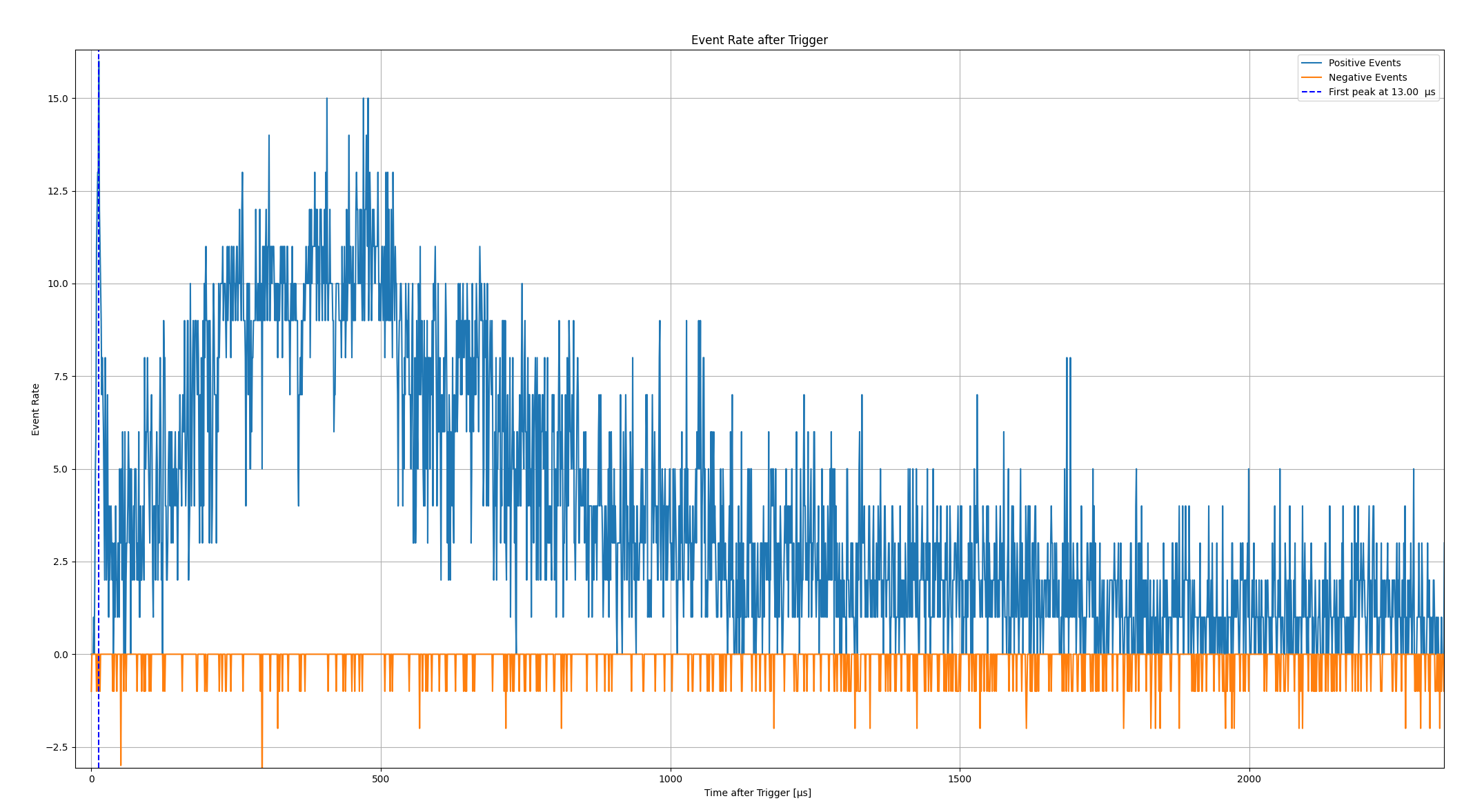
We consistently receive a sharp peak with a delay as low as 2-15us after the trigger event, followed by sharp drop and then a slower gradual rise over the next 200-1000us (the LED remains on during this time)
We find that the delay is strongly influenced by the light brightness. If we instead select a ROI of bounced light or place a diffuser over the LED, the onset drops to 20-100us.
We just wanted to clarify if we are not observing:
- Some artificial delay in the trigger signal in order to align it with the optical events
- Electrical interference
- Pixel noise
Question
Our main question is if anyone else has observed this and what would be the most likely explanation.
Additional, I think the definition of pixel-latency is not quite precise.
- Is it the time from an event until the first pixel fires? (in which case it would be ~5us)
- Is it the time it takes for the pixels to settle after a positive event? (in which case it would be 1000us)
- Is it the average of these values?
- What brightness is it measured at?
Thank you!